

Planning as a Path to Freedom
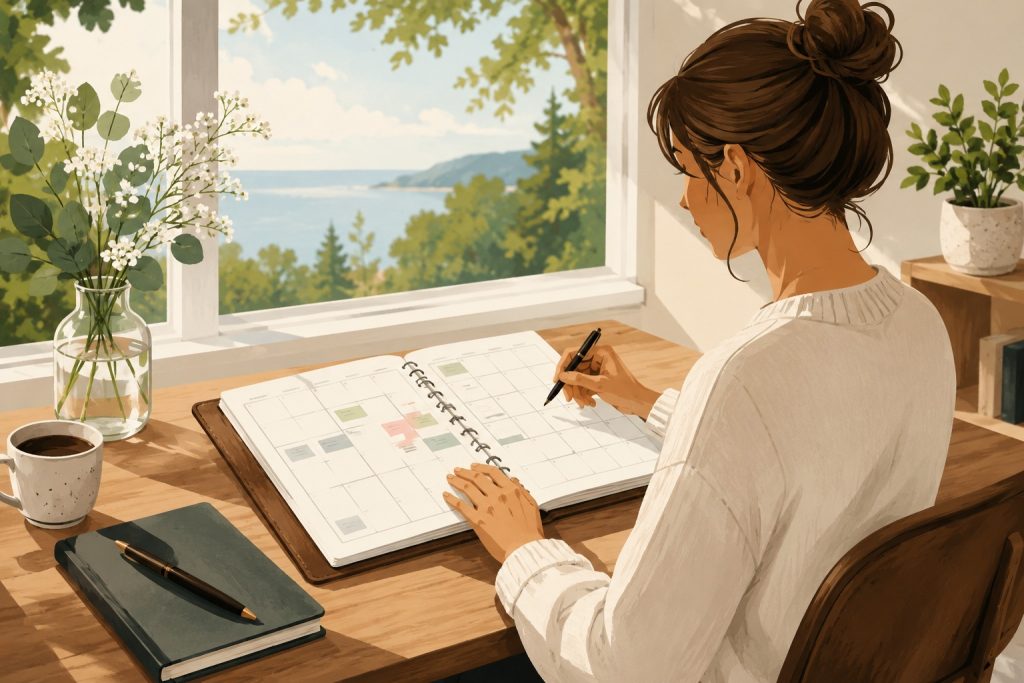
Some people plan everything. Others constantly improvise. Most of us tend to fall more into one category or the other.
There’s something reassuring about planning: it gives us a sense of control over our schedule and our time, and allows us to picture in advance how a day—or even an entire week—will unfold. We feel like we’re on familiar ground, we move forward with confidence, and there’s a certain satisfaction in getting things done and crossing them off our to-do list.
On the other hand, organizing everything in advance can be counterproductive when the tasks or projects on the agenda don’t align with our energy in the moment. Forcing yourself into a long strategic thinking session when your body is itching to move is hardly optimal. Neither is tackling administrative tasks when your brain is buzzing with creative ideas.
Planning, then, isn’t without its downsides. As with almost everything in life, it’s a matter of balance. The key is flexibility. The idea is to build a concrete, realistic and achievable plan while giving yourself permission to rearrange the pieces. To play around with them a little. As long as the end result still aligns with the original goal.
When Rigor Becomes Rigidity
This is where many people struggle. Those who tend to plan everything often confuse rigor with rigidity. Discipline with stubbornness. For any plan to be effective, it has to take into account the person carrying it out. Of course, over time, we get to know ourselves better and learn to plan around our natural rhythms.
Some people need to move their bodies early in the morning to get their energy flowing, while others prefer to exercise in the late afternoon to release the stress that has built up throughout the day. Some are creative at dawn; others find that ideas start flowing once night falls. It’s simply a matter of paying attention to these details and factoring them into the way we plan.
When planning is healthy and sensible, it doesn’t stand in the way of freedom. On the contrary, it makes freedom possible.
The Illusion of Freedom
I sometimes hear people say they’re allergic to planning because it stifles their freedom or spontaneity. I disagree. Because what I most often see in those same people is a false sense of freedom.
When we don’t plan anything and constantly improvise, we naturally tend to gravitate toward the things we enjoy—the tasks that feel easy and fun—while putting off the things that are important, even essential. We also fail to assign a specific amount of time to each task, and end up spending far more time on them than necessary. In the moment, we may feel free because we get to decide what occupies our attention at any given time and how much time we devote to it. But eventually, the important tasks catch up with us and suddenly become urgent. There’s no escaping them anymore.
When Urgency Takes Over
That’s when our own lack of organization traps us. We have no choice but to deal with emergencies, under pressure, and that pressure creates anxiety, if not outright aversion or resentment. We get angry at the urgency of the situation—or at ourselves. Our thinking becomes muddled. And the task that was simply less enjoyable to begin with becomes irritating and exhausting.
At the other end of the spectrum are those who have few obligations, if any. A lack of planning can have negative effects here too: when we have no goals or short- or medium-term objectives, we deprive ourselves of the satisfaction that comes from achieving them. That sense of accomplishment eludes us, and our sense of purpose can begin to feel more elusive as well.
Planning to Make Room for Spontaneity
For me, the ideal lies at the intersection of healthy planning and spontaneity. I carefully plan everything that contributes to achieving my goals—in other words, everything that is non-negotiable for me—and then adapt based on my capacity and energy in the moment.
And you know what? Despite being self-employed, with work that could theoretically never end, despite being a single parent, having a house to maintain, yoga classes to teach and workouts at the gym, I almost never have emergencies. More importantly, I have plenty of little empty spaces in my calendar. Spaces I have fun filling spontaneously—with a family outing to a water park on a Wednesday, or a long walk with a friend on a Friday afternoon.
To me, that’s what real freedom looks like.
**
Would you like to become better at planning, but don’t know where to start? I can help you take those first steps.